Subtracting Two Surfaces (.cube files) for Calculating Fukui Functions

Hello all, I'm trying to calculate Fukui functions [1] using orca, I'm trying to recreate the plots mentioned in [1] as well. Briefly, I have generated two surface files f_n+1.cube and f_n.cube. I tried running in ChimeraX's console ``` open f_n+1.eldens.cube format cube open f_n.eldens.cube format cube volume subtract #1 #2 ``` But I get is a histogram on side with the level slider, and none of the levels match with the output figure on [1]. I'm not sure how to proceed ahead. Am I missing something, isn't there a surface subtract? rather than volume subtract. The files I used for the plots are in [2]. Regards hisacro. [1]: https://www.faccts.de/docs/orca/5.0/tutorials/react/FUKUI.html [2]: https://displ.nl/pb/lactone2.tar.xz

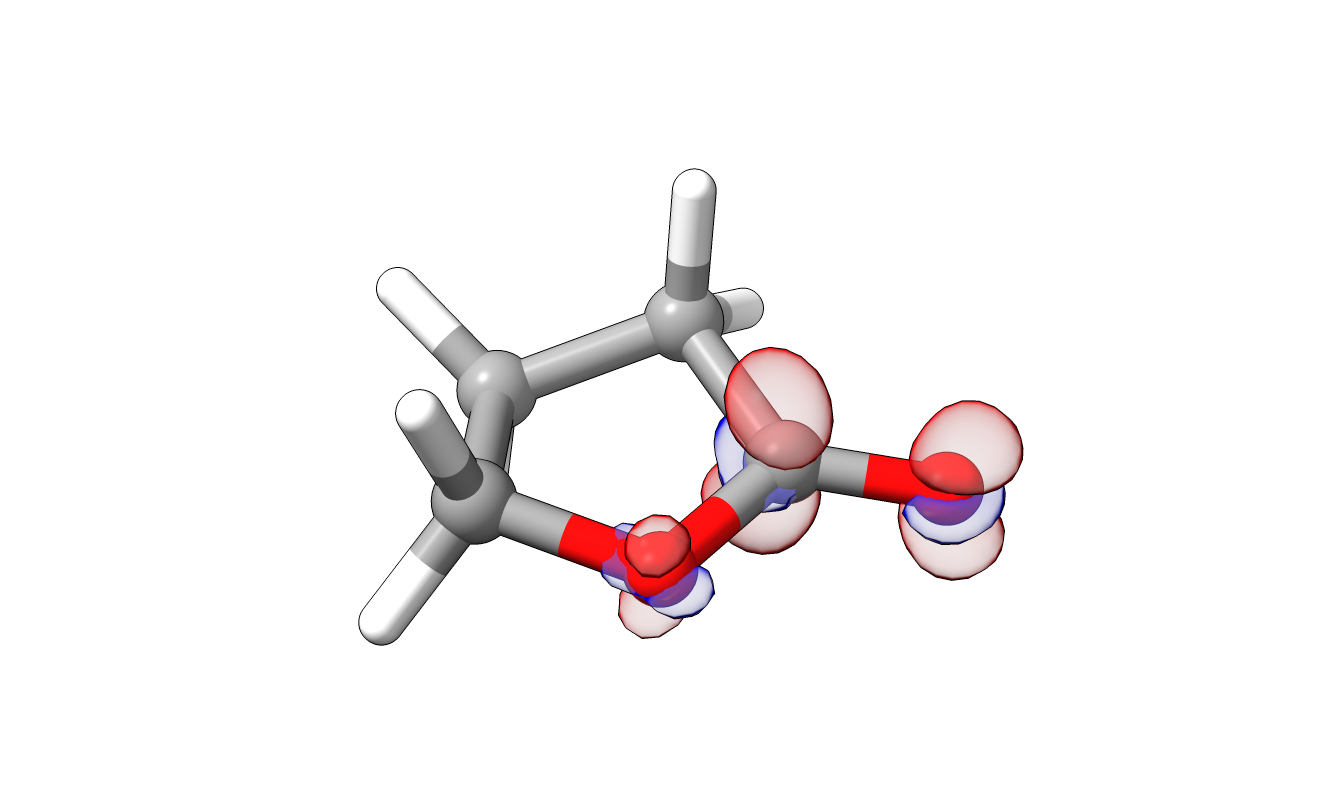
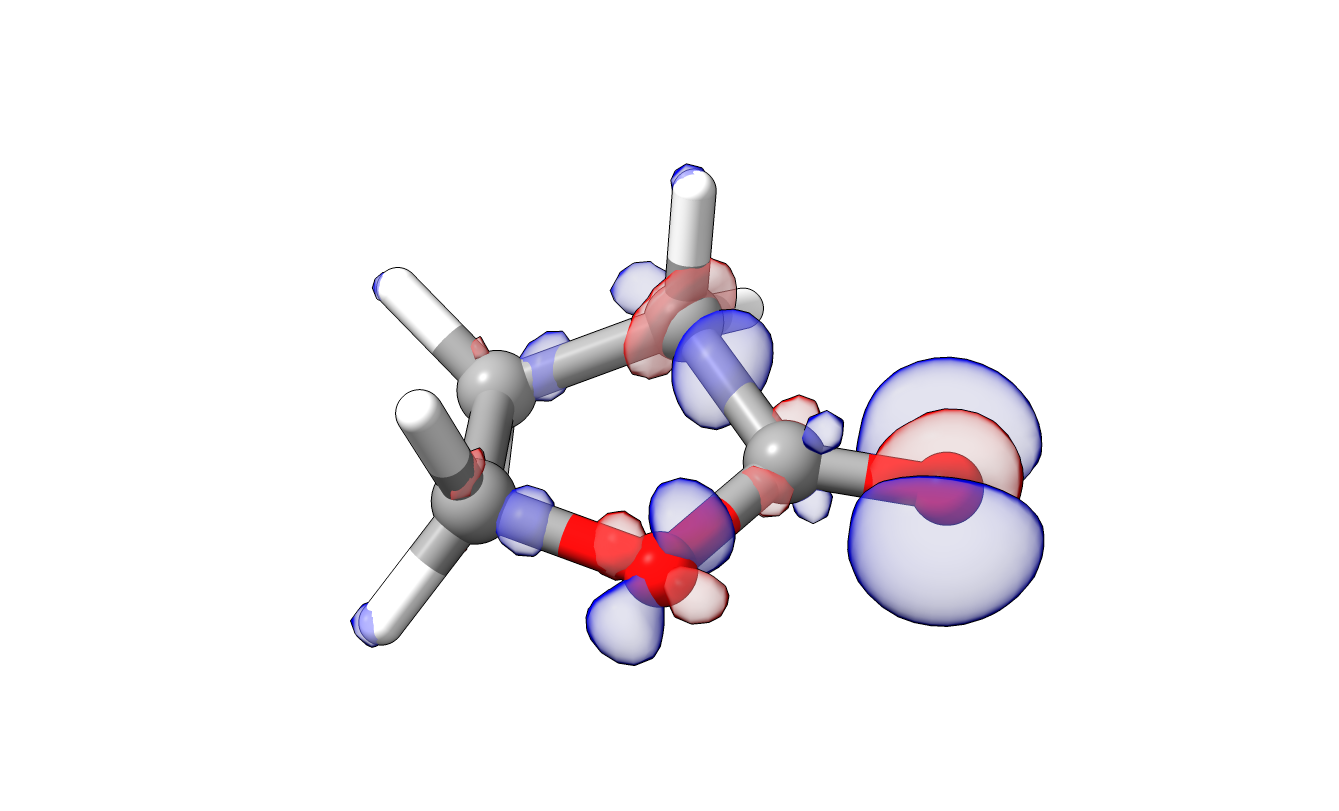
Hiscaro, I played around with your files a bit, and I found that the isosurfaces at 0.01/-0.01 look pretty similar to what's in the orca documentation. The orca page doesn't mention what they set the contour value to, so I'm not sure if this is exactly the same. I also recalculated the cube files with orca_plot using a 100x100x100 grid, as the default 40x40x40 was coarse enough that I had trouble seeing the smaller lobes. Here's the command I used to set the isosurfaces and colors: volume #5 level -0.01 level 0.01 color #0000ff5c color #ff00005c (the result of the volume subtract command was in model #5) I've attached images showing the fukui functions with these settings. If you have any other questions, let me know. Best, Tony On Wed, Jan 14, 2026 at 11:48 PM fsl--- via ChimeraX-users < chimerax-users@cgl.ucsf.edu> wrote:
Hello all,
I'm trying to calculate Fukui functions [1] using orca, I'm trying to recreate the plots mentioned in [1] as well. Briefly, I have generated two surface files f_n+1.cube and f_n.cube. I tried running in ChimeraX's console
``` open f_n+1.eldens.cube format cube open f_n.eldens.cube format cube volume subtract #1 #2 ```
But I get is a histogram on side with the level slider, and none of the levels match with the output figure on [1]. I'm not sure how to proceed ahead.
Am I missing something, isn't there a surface subtract? rather than volume subtract. The files I used for the plots are in [2].
Regards hisacro.
[1]: https://www.faccts.de/docs/orca/5.0/tutorials/react/FUKUI.html [2]: https://displ.nl/pb/lactone2.tar.xz _______________________________________________ ChimeraX-users mailing list -- chimerax-users@cgl.ucsf.edu To unsubscribe send an email to chimerax-users-leave@cgl.ucsf.edu Archives: https://mail.cgl.ucsf.edu/mailman/archives/list/chimerax-users@cgl.ucsf.edu/
On Thu, Jan 15, 2026 at 12:54:40AM -0700, Tony Schaefer wrote:
Hiscaro,
I played around with your files a bit, and I found that the isosurfaces at 0.01/-0.01 look pretty similar to what's in the orca documentation. The
Hello Tony, Wow! I was doubting the calculations but this is exactly what I wanted, I didn't know the volume had two level parameters to adjust. Also I was getting confused with N+1, N-1 but now it's all clear.
orca_plot using a 100x100x100 grid, as the default 40x40x40 was coarse
Exactly, I just realized it. I also tried with 150^3 grid for smoother results. Attached the images. Btw, what present do you use for image generation. It's looking cleaner. My next step is calculating the condensed Fukui functions and adding as a label to compounds. P.s: I had so much fun getting these work, and moreover ChimeraX images look better than the orca examples ;)
Hisacro, Yes, it's interesting that adding/removing an electron can cause some areas to have a lower/higher electron density compared to the parent molecule. I don't think this is always the case, but it happens here so we do need two contour values to show that. I use the ball-stick-endcap preset from seqcrow. It might be worth mentioning that seqcrow's orbital viewer tool can calculate weighted approximate Fukui functions. These weight the occupied and unoccupied orbitals based on their energy relative to the HOMO/LUMO to approximate the Fukui functions using only a single calculation of the molecule with N electrons (without additional computations for N+1 and N-1). I haven't done much testing to compare how close this gets to the proper Fukui functions, but it can show both surfaces and the condensed values. The method it uses for approximating the Fukui functions is here https://onlinelibrary.wiley.com/doi/10.1002/jcc.24699 or here https://pubs.acs.org/doi/10.1021/acs.jpca.9b07516, and the way it partitions it to get condensed values is described here: https://aarontools.readthedocs.io/en/latest/advanced/algorithm_implementatio... Best, Tony On Thu, Jan 15, 2026 at 2:24 AM hisacro <fsl@displ.nl> wrote:
On Thu, Jan 15, 2026 at 12:54:40AM -0700, Tony Schaefer wrote:
Hiscaro,
I played around with your files a bit, and I found that the isosurfaces at 0.01/-0.01 look pretty similar to what's in the orca documentation. The
Hello Tony,
Wow! I was doubting the calculations but this is exactly what I wanted, I didn't know the volume had two level parameters to adjust. Also I was getting confused with N+1, N-1 but now it's all clear.
orca_plot using a 100x100x100 grid, as the default 40x40x40 was coarse
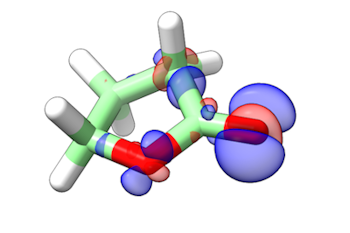
Exactly, I just realized it. I also tried with 150^3 grid for smoother results. Attached the images.
Btw, what present do you use for image generation. It's looking cleaner. My next step is calculating the condensed Fukui functions and adding as a label to compounds.
P.s: I had so much fun getting these work, and moreover ChimeraX images look better than the orca examples ;)
participants (3)
-
 fsl@displ.nl
 -
hisacro
-
 Tony Schaefer