Visualizing contact sites on structures larger than atoms

Hello, I am currently using ChimeraX to reconstruct mitochondria undergoing autophagy. I am interested in visualizing contact sites between the mitolysosome, surrounding mitochondria, and endoplasmic reticulum. The clashes/contacts command<https://www.cgl.ucsf.edu/chimerax/docs/user/commands/clashes.html#options> is all in the context of atoms. Can this command be used for the purpose of larger structures? Or is there another method in ChimeraX to achieve such a visualization? All of my models are surfaces. Best, Melissa Wilson
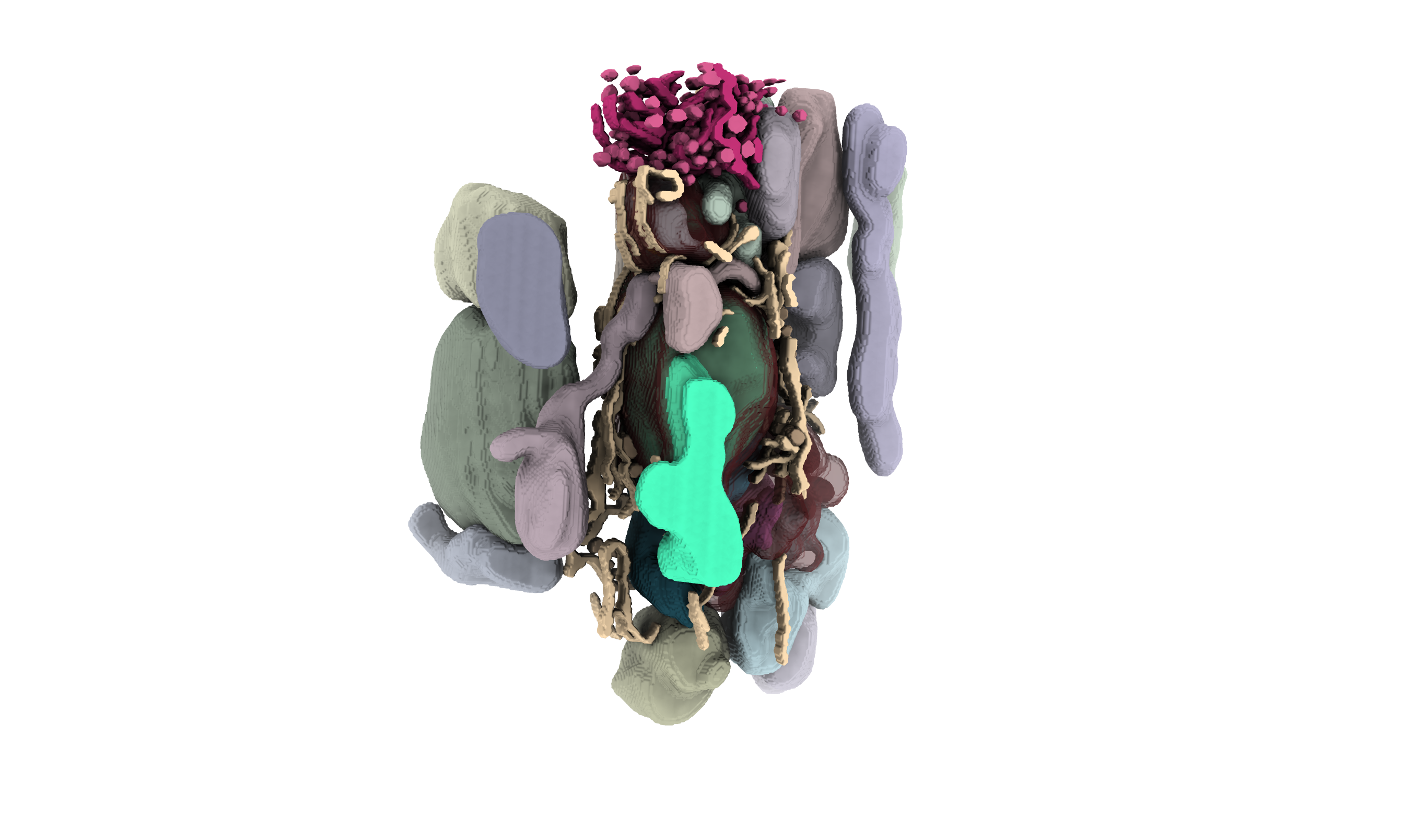

Hi Melissa, Interesting image! Yes, nearly all ChimeraX contact/zone tools are based on atoms: distances to atoms and/or buried surface areas of atoms. There is a "measure contactarea" command that works on two different surface models (not based on atoms) ... however, I suspect it may not be applicable to your surfaces if they are all part of the same single model in ChimeraX, because then there isn't a way to specify them separately. The Models panel should list whether you have multiple models or just one. If you have multiple models, take a look at the command for finding and coloring contact areas between pairs of surface models. <https://rbvi.ucsf.edu/chimerax/docs/user/commands/measure.html#contactarea> I hope this helps, Elaine ----- Elaine C. Meng, Ph.D. UCSF Chimera(X) team Resource for Biocomputing, Visualization, and Informatics Department of Pharmaceutical Chemistry University of California, San Francisco
On Apr 3, 2026, at 8:17 AM, Wilson, Melissa (NIH/NINDS) [F] via ChimeraX-users <chimerax-users@cgl.ucsf.edu> wrote:
Hello, I am currently using ChimeraX to reconstruct mitochondria undergoing autophagy. I am interested in visualizing contact sites between the mitolysosome, surrounding mitochondria, and endoplasmic reticulum. The clashes/contacts command is all in the context of atoms. Can this command be used for the purpose of larger structures? Or is there another method in ChimeraX to achieve such a visualization? All of my models are surfaces. Best, Melissa Wilson<image3.png>
participants (2)
-
 Elaine Meng
 -
 Wilson, Melissa (NIH/NINDS) [F]