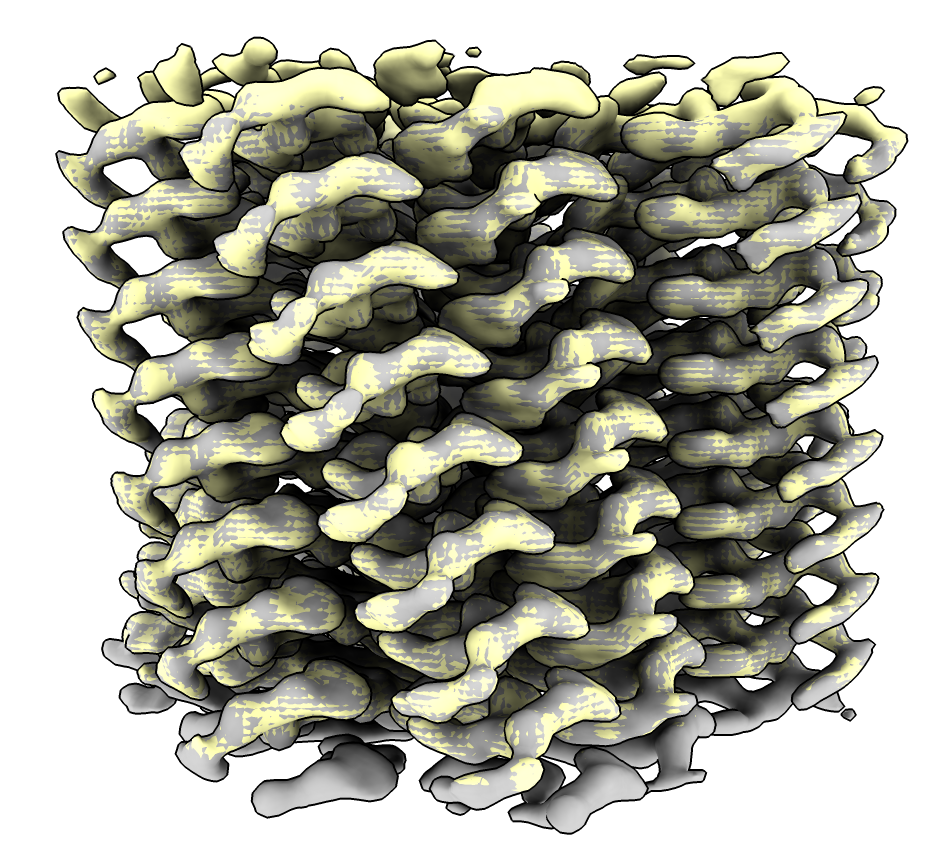
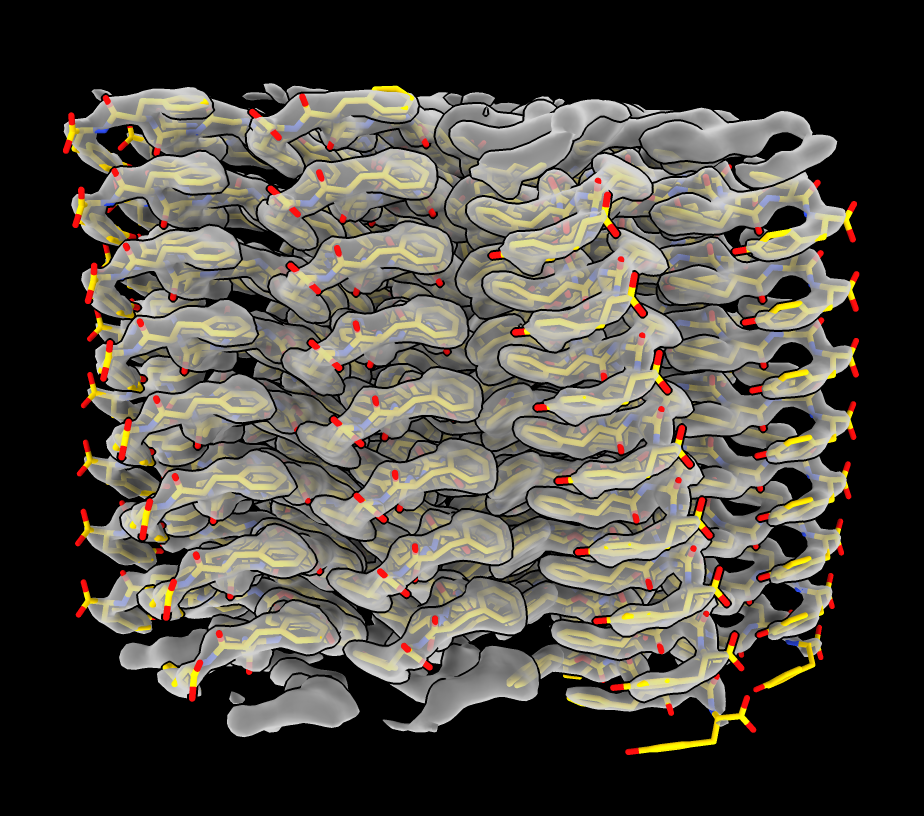
Hi Wendy, Here are some tips. Your map is 512 by 512 by 512 grid points. If you set the threshold to a level where the noise surrounding the structure is hidden save 0.03 (ChimeraX command "volume level 0.03") then you can measure the center points using ChimeraX command "measure center #1" which show the center of the contour surface is at grid point 256,256,256. So setting that ("volume #1 originIndex 256") will put x,y,z = 0,0,0 at that grid point and the symmetry axis should go through that point. To measure more precise helical rotation and rise you can use the ChimeraX measure symmetry command with the helix option (https://www.rbvi.ucsf.edu/chimerax/docs/user/commands/measure.html#symmetry) and I get for your map measure sym #1 helix 1.6,118,1,opt > Symmetry Fmoc-GFFY.mrc: Helix, rise 1.544, angle 118.5, center 256 256 256, n 1 One way to see how accurate these symmetry parameters are is to open a second copy of your map and rotate the second copy 118 degrees and shift by 1.544 Angstroms and see how well it aligns with the first copy of the map. turn z 118.5 model #2 center 0,0,0 coord #2 move z 1.544 model #2 coord #2 Below is an image of the two copies superimposed (gray and yellow) and the speckly appearance means the maps are overlapping nearly perfectly (sometimes the gray shows, sometimes yellow because the align so well). The next step would be to fit in your atomic structures of the asymmetric subunit, sounds like that consists of 3 molecules. Then apply the sym command to each of those to generate an atomic model of the helical filament. If your 3 molecular components are models #3-5 you can combine them into 1 model after you fit them with ChimeraX command combine #3-5. Then you can apply symmetry to that asymmetric subunit with sym #6 h,1.544,118.5,24,-4 center 0,0,0 coord #1 copies true Below is an image of what I get using map and asym unit model. Tom 
On May 7, 2026, at 2:11 AM, Wendy Lera via ChimeraX-users <chimerax-users@cgl.ucsf.edu> wrote:
Hello Tom,
Thanks for the detailed explanation. I will try shifting the origin index of the map as you suggested and see if that helps with the centering issue.
When I said 'several layers', I meant the structure shows nine molecules per layer, connected by a helical rotation of nearly 120° (~118°) and a rise of ~4.8/3, i.e. ~1.6 Å. There are three molecules near the center (related by helical symmetry) and three pairs of molecules located between each of the “central” molecules. Thus, 3 + 2×3 = 3 + 6 = 9.
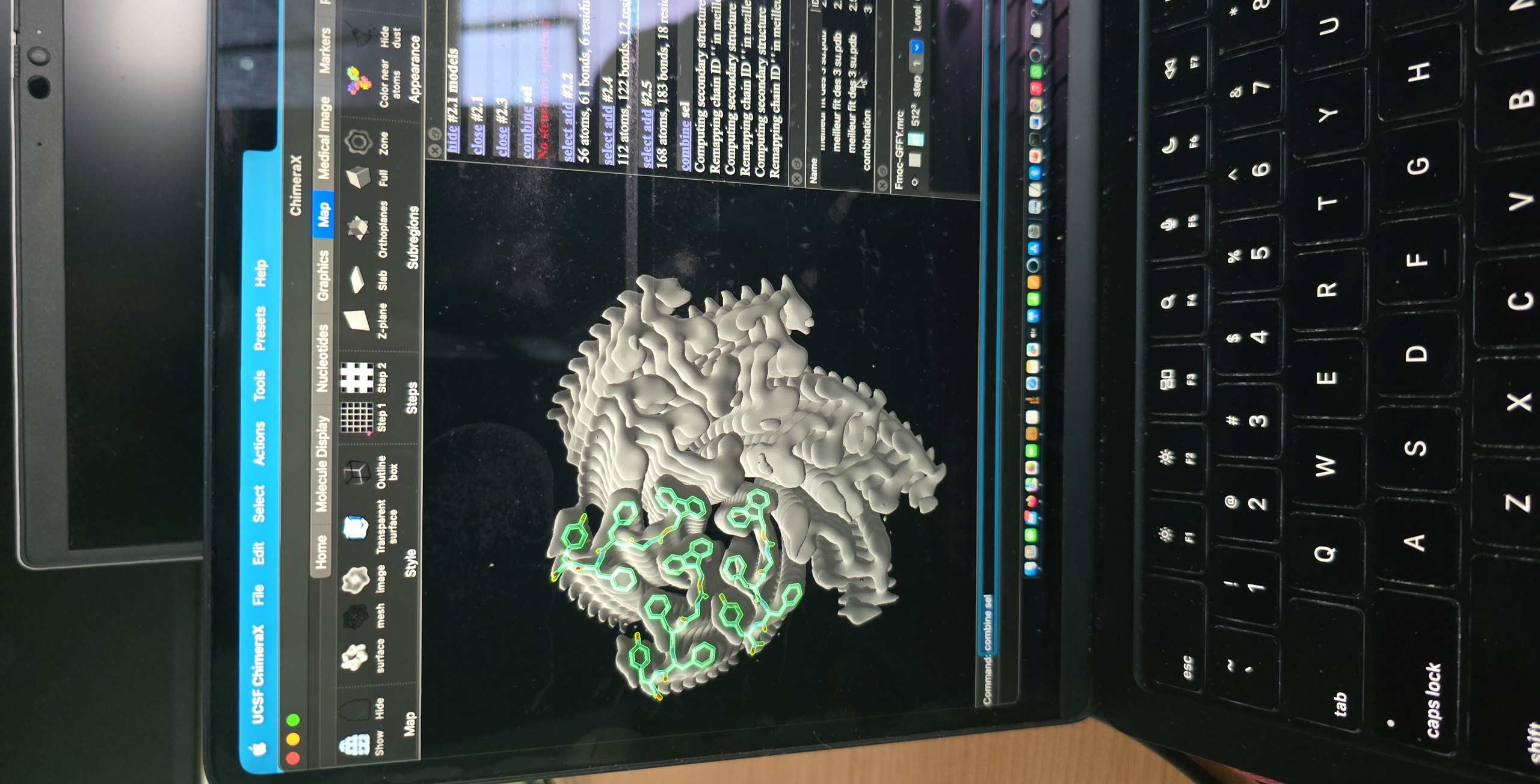
To make it more visual :

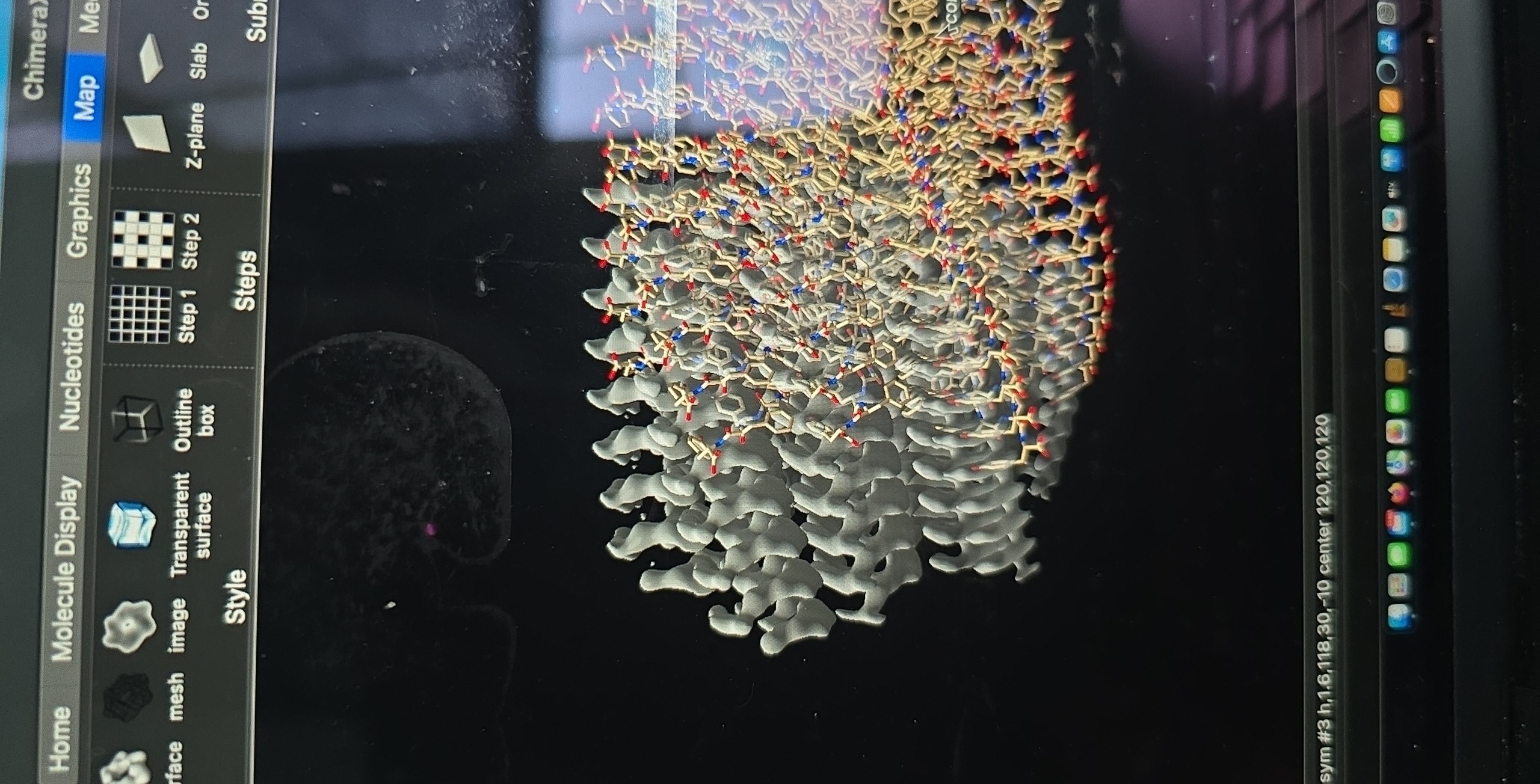
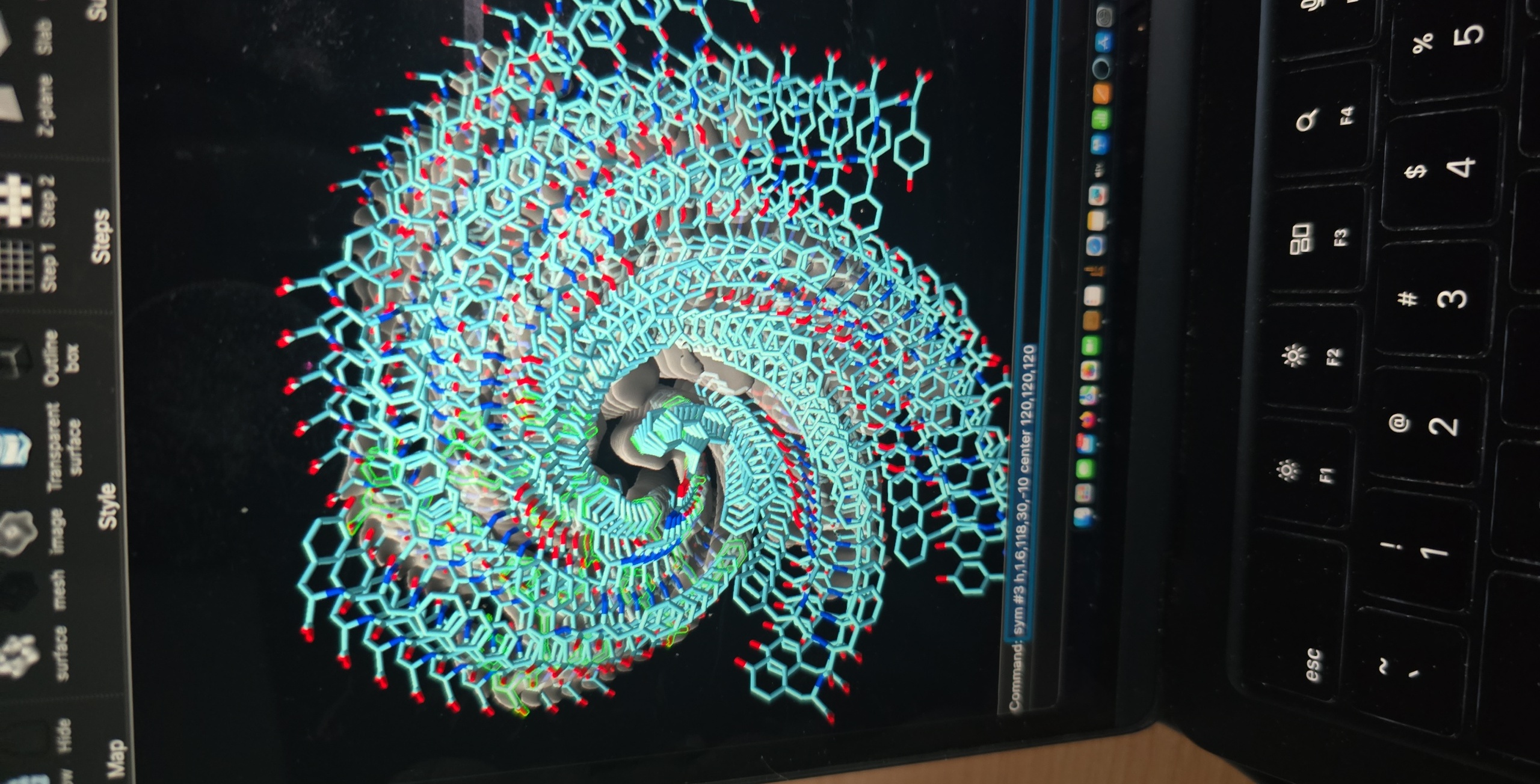
These are the 3 asymetrical subunits, perfectly fit in the map. When I use the parameters of symmetry I obtain this:

1st I would like it to be repeated in 9 layers and perfectly fit.

2nd the center does not seem perfectly aligned. Given that the 3 asymmetrical subunits fit perfectly, I suspect the issue lies Fmoc-GFFY.mrc <https://drive.google.com/file/d/1BCsv54ZCuDtT3qpL3YF-s2wWkJnKoBiG/view?usp=drive_web>with the center coordinates.
PFA the map and the model if you would like to check them yourself. Since ISOLDE lacks the force field for modified residues this makes it even harder. I would like to know if there is a solution before trying other alternative tools.
Thank you and have a nice day, Wendy
On Wed, 6 May 2026, 21:06 Tom Goddard, <goddard@sonic.net <mailto:goddard@sonic.net>> wrote:
Hi Wendy,
I'd need more explanation of the problems to advise. In your command "sym #3 h,1.6,118,30,-10 center 120,120,120" the 30 is the number of repeats of model #3 in the helical assembly. You can of course increase that number to make a longer stretch of helix. I'm not sure what you mean by "several layers". If the assembly is not centered on your map there are various solutions. For helical symmetry maps I think the best approach is to make the symmetry axis the z axis and passing through the origin 0,0,0. You may need to shift the origin index of the map (ChimeraX menu Tools / Volume Data / Map Coordinates). This defines the grid index of the map that is supposed to have x,y,z = 0,0,0. If your map is 240 by 240 by 240 in size the center of symmetry might be at 119,119,119 or 120,120,120 (the two points close to the center of the box). You can save a new .mrc file for the map to remember that center. In addition to get the sym command to produce a helical atomic model that fits you would start with one copy of your asymmetric model fit into the map, then use the sym command on it.
Docs for sym command
https://www.cgl.ucsf.edu/chimerax/docs/user/commands/sym.html#symmetry
Tom
On May 6, 2026, at 6:04 AM, Wendy Lera via ChimeraX-users <chimerax-users@cgl.ucsf.edu <mailto:chimerax-users@cgl.ucsf.edu>> wrote:
Hello,
I have made the perfect fit between a map and model. However, the center is not well aligned and I can not repeat it in several layers. Check the images and the command used..how can I make this work?
_______________________________________________ ChimeraX-users mailing list -- chimerax-users@cgl.ucsf.edu <mailto:chimerax-users@cgl.ucsf.edu> To unsubscribe send an email to chimerax-users-leave@cgl.ucsf.edu <mailto:chimerax-users-leave@cgl.ucsf.edu> Archives: https://mail.cgl.ucsf.edu/mailman/archives/list/chimerax-users@cgl.ucsf.edu/
_______________________________________________ ChimeraX-users mailing list -- chimerax-users@cgl.ucsf.edu To unsubscribe send an email to chimerax-users-leave@cgl.ucsf.edu Archives: https://mail.cgl.ucsf.edu/mailman/archives/list/chimerax-users@cgl.ucsf.edu/