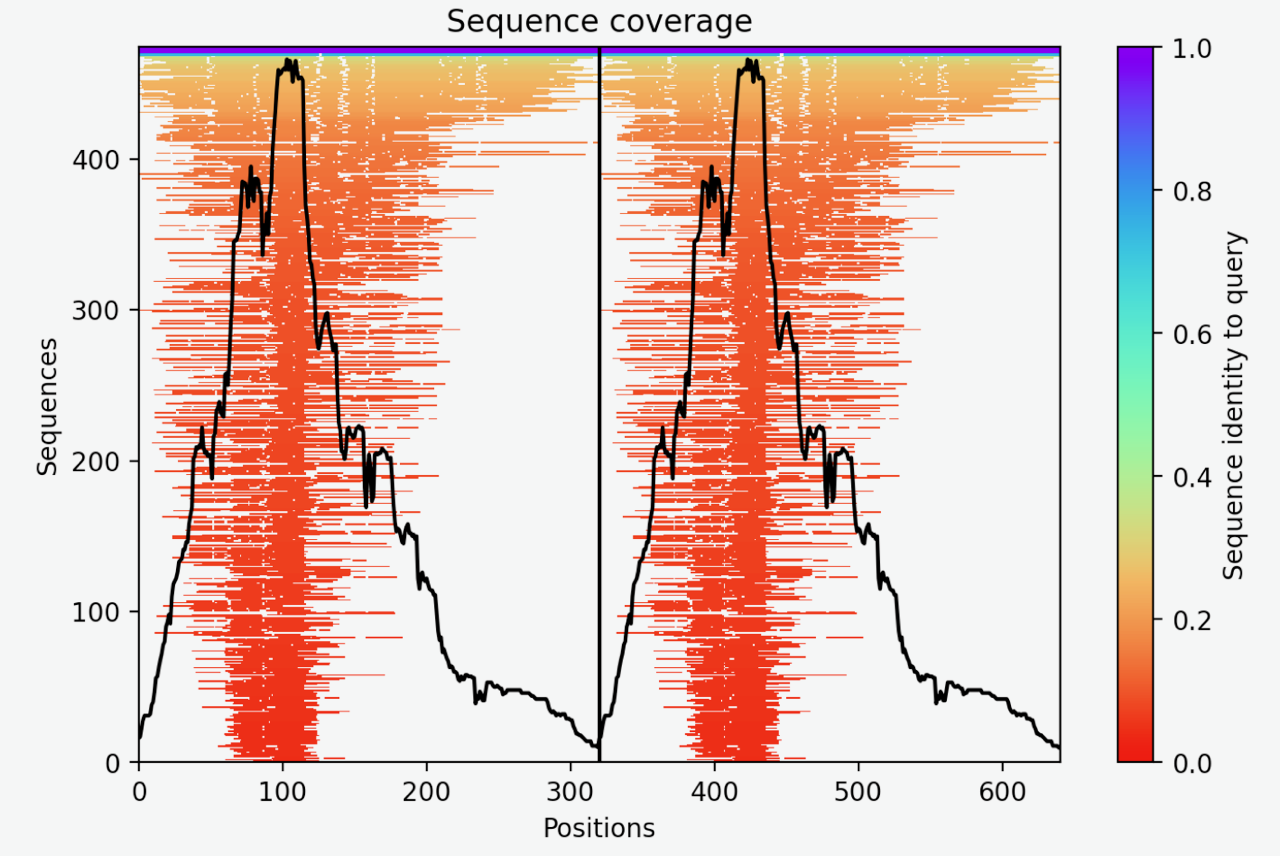
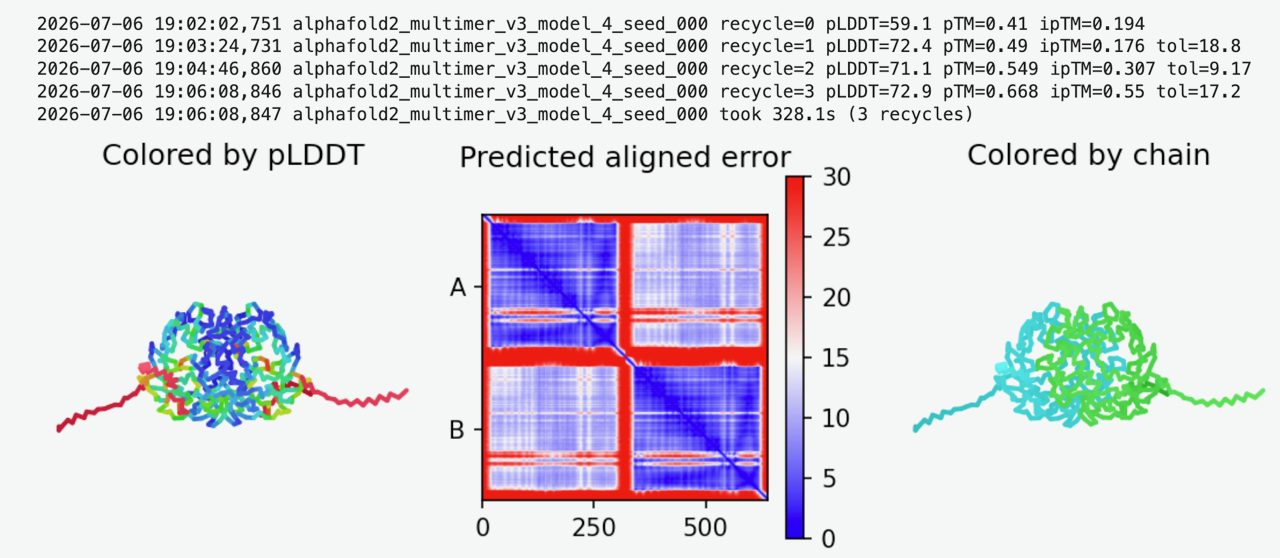
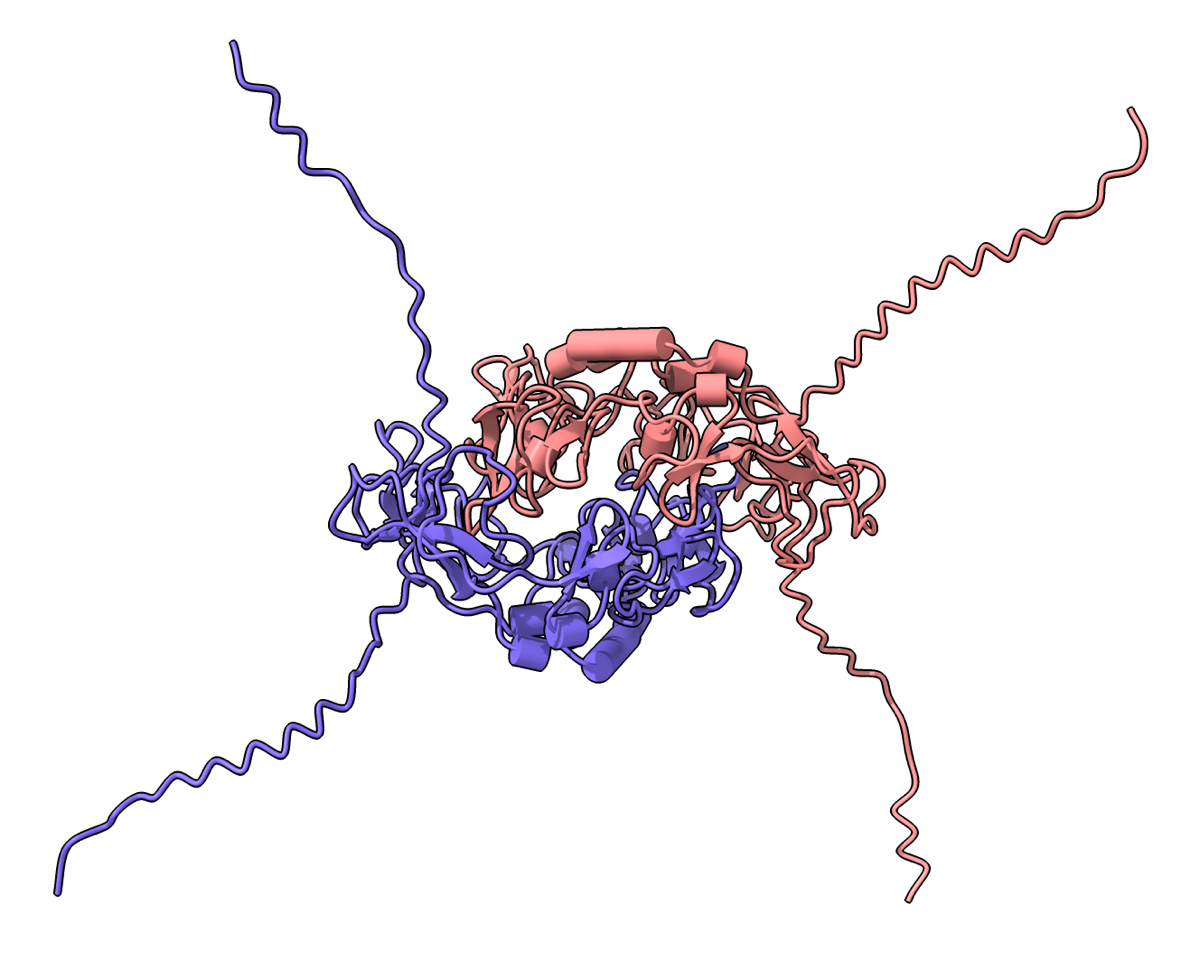
Hi Hiroshi, Machine learning structure prediction programs such as AlphaFold 3, AlphaFold 2, Boltz 2, and OpenFold 3 are not always able to correctly predict protein-protein interactions. These methods all use a multiple sequence alignments (MSA) computed from similar sequences from databases containing as many as a few billion experimentally observed sequences. If there are few known sequences similar to the one you are predicting this can result in poor quality predictions. In the case of your cell-cell adhesion protein gp64 from Polysphondylium pallidum (UniProt Q52085) there are very few similar sequences, only a few hundred. High quality predictions usually have MSAs containing thousands of sequences. ChimeraX can run predictions using AlphaFold 2 (menu Tools / Structure Prediction / AlphaFold), or Boltz 2, or OpenFold 3. I ran your dimer with all 3 of these methods and also with Google's AlphaFold 3 server. With Boltz 2, OpenFold 3, and AlphaFold 3 I got very poor interface predicted TM scores (ipTM) of 0.19, 0.16, and 0.23 similar to what you report. This indicates those programs have no confidence that the dimer interface is correct. Interestingly AlphaFold 2 (run using ChimeraX on Google Colab), which is by far the oldest of these 4 prediction programs (July 2021) gave an ipTM score of 0.55. That is still not a very confident score. Confident scores would be around 0.8 - 1.0. But it might be worth looking at the AlphaFold 2 predictions. I've attached the AlphaFold 2 prediction results (results.zip) below. Tom Here is the AlphaFold 2 sequence coverage plot showing it used an MSA with about 450 similar sequences, although only about 5 had high similarity (blue color).  Here is the AlphaFold 2 best prediction out of 5. The predicted aligned error plot off-diagonal blocks indicate some confidence in the dimer interface.  Here is an image of the dimer in ChimeraX  
On Jul 4, 2026, at 10:29 PM, 落合廣 via ChimeraX-users <chimerax-users@cgl.ucsf.edu> wrote:
Dear DR. Thank you for using chimeraX. I am very impressed with the development of protein assembly analysis technology. I am an elderly (88-year-old) biochemist. I have a question. ○1. Even if dimer formation is analyzed by AlphaFold 3, dimers with interfaces are not recognized at all (AlphaFold has a list of 19(?) analyzed). Why? ○2. Even though dimer formation (54 or 132 interface residues) can be seen by chimeraX, when looking at ipTM with AlphaFold, a number such as 0.19 is not recognized as a dimer. Do you think that this is because AlphaFold does not take into account that proteins such as GPI membrane proteins are kept in anti-parallel, do you have an opinion? With best Regards
Hiroshi Ochiai Research Institute for Electronic Sciences, Hokkaido University, Sapporo Japan Emeritus Professor _______________________________________________ ChimeraX-users mailing list -- chimerax-users@cgl.ucsf.edu To unsubscribe send an email to chimerax-users-leave@cgl.ucsf.edu Archives: https://mail.cgl.ucsf.edu/mailman/archives/list/chimerax-users@cgl.ucsf.edu/